
Press release distribution is the process of broadcasting your announcement through professional wire services to AP News, Yahoo Finance, Bloomberg, and hundreds of other outlets simultaneously
Introduction
Every day, thousands of U.S. businesses have stories worth telling. A startup closes its first major funding round. A mid-size company launches a product that solves a problem millions of people face. A regional brand wins a prestigious industry award. A healthcare organization publishes research that could change how doctors treat patients across the country. These are genuinely newsworthy stories — but without an effective system for getting them in front of journalists, editors, and audiences, they disappear into the noise of a crowded media landscape.
Press release distribution is the system that bridges the gap between your story and the audiences who need to hear it. It is the process of delivering your press release to journalists, editors, news outlets, investors, and search engines through professional, trusted channels that ensure your announcement reaches the people with the power to amplify it.
Yet despite its importance, press release distribution remains one of the most misunderstood disciplines in modern business communications. Many business owners believe that writing a press release is the hard part — and that once the release is written, getting it out into the world is simply a matter of sending a few emails. The reality is far more strategic.
Distribution is not an afterthought to the writing process. It is a discipline in its own right, with its own tools, best practices, and potential pitfalls — and doing it correctly can be the difference between zero media coverage and your story appearing on AP News, Yahoo Finance, Bloomberg, and Reuters simultaneously.
This guide covers everything you need to know about press release distribution in 2026. You will learn what it is, how it works step by step, why it matters for businesses of every size, what the best practices are, which mistakes to avoid, and how to choose the right press release distribution service for your specific goals. Whether you are distributing your first press release or looking to elevate an existing PR program, this guide gives you the complete foundation you need.
If you are also working on the writing side of your press release strategy, our companion guides on how to write press releases that get picked up by the media and how to find and target the right journalists will give you the complete end-to-end system for earned media success.
- Introduction
- What Is Press Release Distribution?
- Why Press Release Distribution Matters for Businesses
- How Press Release Distribution Works
- Step-by-Step Guide to Press Release Distribution
- Benefits of Using a Press Release Distribution Service
- Best Practices for Successful Press Release Distribution
- Common Press Release Distribution Mistakes to Avoid
- How Press Release Distribution Helps Businesses Gain Media Exposure
- Frequently Asked Questions About Press Release Distribution
- Conclusion
What Is Press Release Distribution?

Press release distribution is the professional process of delivering your business announcement to the journalists, outlets, and investors who need to hear it
Press release distribution is the process of delivering a formally written news announcement — called a press release — to journalists, editors, news organizations, financial platforms, online databases, and search engines through professional channels designed to maximize visibility and media pickup.
A press release is a standardized document that communicates a newsworthy development from a company or organization. It might announce a product launch, a funding round, a merger or acquisition, a new executive hire, a community initiative, research findings, a partnership, or any other development that has genuine public or industry significance. Press release distribution is the mechanism by which that announcement travels from the company that issued it to the media professionals who can amplify it — and ultimately to the public audiences who need to hear it.
In practical terms, press release distribution takes two primary forms:
Wire Distribution
Wire distribution — also called newswire distribution — involves submitting your press release to a professional distribution service that broadcasts it simultaneously to a network of journalists, editors, news outlets, financial platforms, and online databases. When you submit a release through a trusted newswire like NewswireSurge, it is automatically delivered to the editorial feeds and inboxes of journalists at outlets like AP News, Yahoo Finance, Bloomberg, Reuters, Benzinga, and hundreds of industry-specific publications — all at the same time, from a single submission.
Wire distribution is the backbone of professional press release marketing because it provides scale, speed, and credibility that no individual outreach effort can match. Journalists recognize and trust established wire services, which means releases arriving through these channels carry an inherent layer of editorial legitimacy that cold email pitches simply cannot replicate.
Targeted Direct Outreach
Direct outreach involves identifying specific journalists who cover your beat and sending them personalized pitch emails that accompany your press release. This approach complements wire distribution rather than replacing it. While wire distribution ensures broad, simultaneous reach across hundreds of outlets, targeted direct outreach builds the journalist relationships and personal connections that turn wire pickups into original editorial features.
The most effective press release distribution strategies combine both approaches — using a trusted newswire service for broad simultaneous reach and targeted personal outreach for priority journalist relationships. This two-pronged system is covered in depth in our guide on how to find and target the right journalists for your press release.
The History and Evolution of Press Release Distribution
Press release distribution has existed in some form since the early twentieth century, when companies first began sending formal written announcements to newspaper editors. The modern wire service model — where a central service broadcasts releases simultaneously to a wide network of media contacts — was pioneered in the 1950s by services like PR Newswire and Business Wire, which established the infrastructure of professional press release distribution that still underpins the industry today.
The internet transformed press release distribution dramatically. Online press release distribution platforms made it possible for businesses of all sizes — not just large corporations with dedicated PR departments — to access professional distribution networks. The rise of digital news platforms, financial data aggregators, and social media further expanded the destinations that press releases could reach, while search engine indexing added an entirely new SEO dimension to distribution strategy.
In 2026, press release distribution is simultaneously more accessible and more competitive than at any point in its history. The barrier to entry is low — any business can submit a release through a professional service within minutes. But the competition for journalist attention and media pickup is intense, making the quality of both the release and the distribution platform more important than ever.
Why Press Release Distribution Matters for Businesses

Press release distribution matters because it is the only marketing channel that simultaneously generates DA 90 plus backlinks, earned media coverage, and investor visibility
Some business owners question whether press release distribution is still relevant in an era of social media, content marketing, and influencer partnerships. The answer is a clear and emphatic yes — and the reasons are more compelling in 2026 than they have ever been.
It Builds Third-Party Credibility That Self-Promotion Cannot
When your company publishes a blog post or a social media announcement, audiences understand that they are reading your own version of events. When a respected news outlet covers your story — whether as an AP News wire pickup, a Yahoo Finance article, or a Bloomberg mention — that coverage carries the credibility of a trusted third party. This is the fundamental value proposition of earned media, and professional press release distribution is the primary mechanism for earning it.
Third-party credibility influences every stakeholder group your business interacts with. Investors are more likely to take a meeting with a company that has Bloomberg coverage. Enterprise customers are more likely to trust a vendor that appears regularly in industry trade publications. Job candidates are more likely to apply to a company with a visible media presence. Press release distribution builds the kind of external validation that accelerates every aspect of business development.
It Drives Measurable SEO Results
Every press release distributed through a quality online press release distribution service and published on high-authority outlets generates backlinks from domains that Google trusts. A single release distributed through NewswireSurge and published on AP News, Yahoo Finance, and Bloomberg can generate backlinks from domains with Domain Authority scores, as measured by Moz, above 90 — links that strengthen your website's search rankings and drive organic traffic for months after the initial distribution. Our dedicated guide on press release SEO covers this dimension of distribution strategy in full detail.
It Reaches Audiences at Scale
No individual outreach effort can reach the same audience size as a professionally distributed press release. A single submission to NewswireSurge can simultaneously reach journalists at hundreds of outlets, financial analysts monitoring wire feeds, investors tracking industry developments, and potential customers searching for solutions in your category. This simultaneous, multi-audience reach is unique to professional newswire distribution and cannot be replicated through social media, email marketing, or direct outreach alone.
It Supports Every Stage of Business Growth
Press release distribution is not exclusively for large corporations. Startups use it to build early credibility and attract investor attention. Growth-stage companies use it to announce milestones that signal momentum to the market. Established enterprises use it to maintain brand visibility, manage reputation, and communicate directly with the financial community. At every stage of business development, strategic press release distribution accelerates visibility and credibility in ways that compound over time.
How Press Release Distribution Works
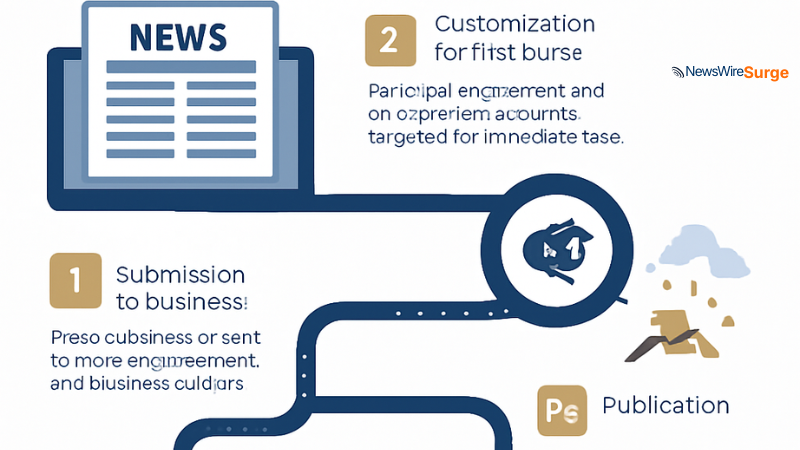
How press release distribution works, your release enters professional wire feeds and is simultaneously broadcast to AP News, Yahoo Finance, Bloomberg, Reuters, and hundreds of other outlets
Understanding the mechanics of press release distribution helps you make better decisions about how to write your releases, which distribution channels to use, and how to set realistic expectations for the results you will earn. Here is how the process works from submission to publication.
The Distribution Pipeline
When you submit a press release to a professional press release service like NewswireSurge, the release enters a distribution pipeline that moves through several stages before reaching its final destinations:
- Submission and editorial review: You submit your press release through the distribution platform's interface, providing the release text, headline, multimedia assets, targeting preferences, and distribution timing. Quality distribution services conduct a basic editorial review to ensure the release meets formatting standards and content guidelines before broadcasting it.
- Wire broadcast: At your specified release time, the distribution service broadcasts your press release simultaneously to its entire network — which for platforms like NewswireSurge includes AP News, Yahoo Finance, Bloomberg, Reuters, Benzinga, and hundreds of industry and regional publications. This broadcast happens in real time, with all destinations receiving the release simultaneously.
- Syndication and publication: Outlets in the distribution network that have automatic publication agreements with the wire service publish your release immediately upon receipt. Other outlets — particularly those where editorial judgment determines what gets published — review the release and may publish it, assign a reporter to cover it, or pass on it depending on newsworthiness and editorial fit.
- Indexing: Published press releases are indexed by Google and other search engines, typically within hours of publication. They also appear in financial data terminals, news aggregators, and industry databases that monitor the wire feeds.
- Analytics and reporting: Your distribution platform provides a performance report showing which outlets published your release, how many views it received, what backlinks were generated, and how your distribution investment performed against key metrics.
How Journalists Interact with Distributed Releases
Journalists interact with distributed press releases through multiple channels. Many monitor wire feeds directly through their newsroom's subscription to AP, Reuters, or a commercial newswire service. Others receive email digests of wire releases filtered by industry or beat. Some discover releases through Google News searches. Financial journalists and analysts often monitor releases through Bloomberg or Refinitiv terminals that aggregate newswire content in real time.
When a journalist encounters your release and finds it newsworthy, they have several options: publish the wire version directly on their platform, write an original article based on the release's news angle, contact you for additional information or a source interview, or save it for future reference when covering a related topic. The quality of your press release — its news angle, structure, data, and readability — determines which of these responses you earn.
The Role of Targeting in Distribution
Professional press release distribution services allow you to target your release by industry vertical, geographic region, and media type. This targeting ensures that your release reaches the journalists and outlets most likely to find it relevant — increasing pickup rates and ensuring that the coverage you earn reaches the audience most likely to care about your story.
A healthcare company distributing a clinical research announcement should target health and medical journalists, not retail or technology reporters. A regional restaurant group announcing a new location should target local and regional food and business journalists, not national financial media. Effective targeting is one of the most important levers available in press release distribution, and it is covered in detail in our guide on how to find and target the right journalists for your press release.
Step-by-Step Guide to Press Release Distribution

The step-by-step press release distribution process from writing and submission through broadcast, journalist follow-up, and analytics review
Whether you are distributing your first press release or building a systematic press release marketing program, this step-by-step process gives you a reliable framework for every distribution cycle.
Write a Press Release That Meets Professional Standards
Effective distribution begins with an effective press release. Before choosing a distribution channel or submitting a release, ensure your content meets the journalistic standards that editors at top outlets expect. Your release needs a strong news hook, a data-backed lead paragraph, neutral tone, verifiable facts, credible quotes, and proper AP style formatting. A poorly written release distributed through the best service in the world will still be ignored. Our comprehensive guide on how to write press releases that get picked up covers every element of professional press release writing in detail.
Choose the Right Press Release Distribution Service
Select a distribution platform that has verified syndication agreements with the specific outlets you want to reach. If your goal is coverage on AP News, Yahoo Finance, Bloomberg, and Reuters, you need a service with direct connections to these platforms — like NewswireSurge. Compare services based on outlet network quality, targeting capabilities, multimedia support, analytics depth, and pricing. Our detailed guide on how to choose the right press release distribution service walks you through this decision with a full comparison of the top seven U.S. platforms.
Prepare Your Multimedia Assets
Gather all visual assets before submitting. Every press release should include at least one high-resolution image. Releases with survey data or financial results should include a chart or infographic. Each high-authority backlink from outlets like AP News (DA 94) is worth $1,000 to $3,000 in equivalent link-building value, according to Ahrefs. Major announcements benefit from a short video. Ensure all images are a minimum of 1,200 pixels wide, hosted at a public URL, and accompanied by descriptive captions. Multimedia-ready releases are more likely to be published and shared by journalists who need visual assets for their articles.
Configure Your Distribution Targeting
In your distribution platform, set your industry vertical targeting, geographic targeting, and any additional targeting parameters available. Be as specific as possible — targeted releases reach more relevant journalists and earn higher pickup rates than broadly distributed releases sent to every category simultaneously. If your announcement is relevant to technology, healthcare, and business audiences, target all three categories rather than choosing just one.
Schedule for the Optimal Distribution Window
Time your release for Tuesday through Thursday between 8:00 AM and 10:00 AM Eastern Time — the window when newsroom editors are actively reviewing wire feeds and planning the day's coverage. Avoid Mondays (editorial backlog), Fridays (week-close), weekends, and major holidays. For time-sensitive announcements like earnings releases or regulatory filings, distribute immediately regardless of timing — newsworthiness always takes priority over optimal timing when the two conflict.
Submit Through Your Distribution Platform
Upload your release content, headline, subheadline (if applicable), multimedia assets, boilerplate, and contact information into your distribution platform's submission interface. Review every element carefully before submitting — check for typos, verify all data figures are accurate, confirm that links work correctly, and ensure contact information is current. Errors in a distributed press release are extremely difficult to correct after broadcast and can damage your credibility with journalists who receive the erroneous version.
Send Personalized Pitches to Priority Journalists
Within two to four hours of wire distribution, send personalized pitch emails to your top five to fifteen journalist targets — the reporters at your most important outlets who cover your specific beat. Reference the wire release, include a link to the published version, and offer an exclusive angle or source interview opportunity that goes beyond what is already available on the wire. This double-touch strategy — wire distribution plus targeted outreach — consistently produces higher coverage rates than either approach used alone.
Monitor Results and Respond to Inquiries
Monitor your distribution platform's analytics dashboard in the 24 to 72 hours following distribution. Track pickups, views, backlinks generated, and journalist inquiries. Respond to any journalist questions or interview requests within two hours — speed of response is a critical factor in whether an initial journalist inquiry turns into a published article. Keep your contact person available and briefed for the 72 hours following every major distribution.
Amplify Your Coverage
Share every piece of coverage on your company's social media channels, add coverage logos to your website, feature significant articles in your email newsletters, and use media mentions in your sales and investor materials. Coverage amplification multiplies the value of every placement you earn — extending its reach far beyond the outlet's own readership and building a cumulative media presence that compounds with every release cycle.
Measure, Learn, and Optimize
After each distribution cycle, spend 30 minutes reviewing results and identifying what worked. Which headlines generated the most pickups? Which outlets drove the most referral traffic? Which angles earned journalist follow-up? Which targeting configurations produced the best results? Document these learnings and apply them to your next release. A systematic approach to measurement transforms press release distribution from guesswork into a continuously improving, data-driven program.
Benefits of Using a Press Release Distribution Service

The benefits of using a professional press release distribution service extend far beyond media coverage to include DA 90 plus backlinks, Google News visibility, and investor discovery
While it is technically possible to distribute a press release manually — building your own journalist list and sending individual emails — professional press release distribution services provide advantages that manual outreach simply cannot replicate. Here is a comprehensive look at the benefits that make professional distribution services essential for serious PR programs.
Immediate Access to Top-Tier Media Outlets
The most significant benefit of a professional press release service is immediate access to the editorial feeds of top-tier outlets that individual businesses cannot reach on their own. Outlets like AP News, Yahoo Finance, Bloomberg, and Reuters do not accept cold email pitches from unknown senders — they receive press releases through established wire relationships. NewswireSurge maintains direct syndication to all of these outlets, giving every business that distributes through the platform immediate access to audiences that would otherwise take years of relationship-building to reach.
Simultaneous Multi-Outlet Reach
A single submission to a professional distribution service broadcasts your release to hundreds of outlets simultaneously. No individual outreach effort — regardless of how large your journalist contact list is — can achieve this simultaneous, synchronized reach. For time-sensitive announcements like earnings releases, product launches, or regulatory filings, the ability to reach all relevant outlets at exactly the same moment is not just convenient — it is essential.
Credibility Through Association
Press releases arriving through recognized wire services carry inherent credibility that cold emails do not. Research from Cision shows 73% of journalists rely on wire services as their primary press release source. Journalists who see a release arrive via NewswireSurge or another professional wire know that the release comes from a verified source that has agreed to the platform's content standards. This credibility signal significantly increases the probability that the release will be read and considered rather than immediately discarded.
SEO Value Through High-Authority Backlinks
Every outlet that publishes your press release through wire syndication generates a backlink to your website. When those outlets include AP News (DA 94+), Yahoo Finance (DA 93+), and Bloomberg (DA 93+), the SEO value of those backlinks is extraordinary. A consistent online press release distribution program through NewswireSurge builds a high-authority backlink profile that strengthens your website's search rankings over time in ways that no other content marketing activity can match at equivalent scale and cost.
Professional Analytics and Performance Reporting
Quality distribution services provide detailed performance analytics that allow you to measure the return on your PR investment precisely. Pickup counts, named outlet placements, view metrics, backlink generation data, and geographic distribution of readers give you the information you need to evaluate performance, compare releases, and continuously improve your distribution strategy. This data-driven accountability is not available through manual outreach.
Google News Indexing
Press releases distributed through professional services and published on Google News-approved outlets are indexed in Google News — appearing in news search results and news carousels that reach millions of searchers daily. This search visibility is an additional distribution channel that no amount of direct journalist outreach can create and that compounds with every release you publish.
Time and Resource Efficiency
Building and maintaining a journalist contact list large enough to match the reach of a professional wire service would require thousands of hours of research, constant updates as journalists change roles and outlets, and individual relationship management at a scale that is simply not feasible for most businesses. Professional distribution services compress this entire effort into a single submission, freeing your team to focus on the creative and strategic work of developing newsworthy stories.
NewswireSurge — The Professional Press Release Distribution Service Built for U.S. Business Success
NewswireSurge is the press release distribution service purpose-built to deliver all of these benefits for U.S. businesses of every size. From early-stage startups distributing their first funding announcement to established enterprises managing quarterly earnings communications, NewswireSurge provides the infrastructure, the outlet network, and the editorial support that turns a well-written press release into genuine, high-value media coverage.
When you distribute through NewswireSurge, your press release reaches AP News, Yahoo Finance, Bloomberg, Reuters, Benzinga, MarketWatch, and hundreds of industry-specific publications simultaneously — from a single submission. Every distribution cycle generates high-authority backlinks, Google News indexing, and real journalist attention from the outlets that define business credibility in the United States.
NewswireSurge stands apart from generic newswire distribution services in one critical way: its focus on genuine media pickup rather than vanity metrics. Where other platforms measure success by counting low-authority syndication placements, NewswireSurge measures success by the quality and credibility of the outlets that publish your story. That difference in philosophy produces dramatically better results for the businesses that trust it with their most important communications.
- Direct syndication to AP News, Yahoo Finance, Bloomberg, Reuters, and Benzinga
- Industry and geographic targeting for maximum editorial relevance
- Full multimedia support for publication-ready press releases
- Detailed analytics and named outlet pickup reporting
- Accessible packages for businesses of all sizes and budgets
- Editorial guidance to ensure every release meets journalist standards
- SEO-optimized distribution that builds domain authority with every release
Visit newswiresurge.com to explore distribution packages and start building the media presence your business deserves.
Best Practices for Successful Press Release Distribution

Best practices for successful press release distribution cover writing quality, precision targeting, optimal timing, and personalized journalist follow-up within 2 to 4 hours of broadcast
Professional press release distribution delivers the best results when it is executed with discipline and strategic intention. These best practices represent the accumulated wisdom of thousands of successful PR campaigns and apply regardless of which distribution service you use.
Always Lead with News Value, Not Company Promotion
The most common reason press releases fail to earn coverage is that they read like advertisements rather than news. Every element of your release — the headline, the lead paragraph, the body copy, the quotes — should be framed around what your announcement means for the audience, not what it means for your company. Journalists are not interested in helping you promote your brand. They are interested in telling stories their readers care about. Frame your announcement as that story.
Distribute Consistently, Not Just for Major Announcements
The brands that earn the most consistent media coverage through press release marketing are those that release regularly — every four to six weeks — rather than sporadically. Consistent distribution builds journalist familiarity with your brand, creates a growing Google News presence, and generates a compounding backlink profile that grows stronger with every release. Find newsworthy angles in your regular business activities: quarterly data updates, industry trend commentary, community initiatives, partnership announcements, and milestone achievements all qualify.
Optimize Every Release for Both Journalists and Search Engines
As covered in our guide on press release SEO, the best press releases are optimized for both human readers and search algorithms simultaneously. Include your primary keyword naturally in the headline and first paragraph, use subheadings that incorporate secondary keywords, and include a keyword-rich anchor text link back to a relevant page on your website. This dual optimization maximizes the value of every release across both earned media and organic search channels.
Include High-Quality Multimedia with Every Release
Releases with high-resolution images, data visualizations, or video are significantly more likely to be published in full by journalists who need visual assets for their articles. Make it as easy as possible for journalists to publish your story by providing everything they need in the release itself — do not make them work for assets that you could have included from the start.
Write an Irresistible Headline
Your headline is the first — and often only — thing a journalist sees before deciding whether to read your release. It must communicate your news value immediately, include a specific data point where possible, and avoid promotional language entirely. A headline that includes a number, a clear benefit or impact, and a relevant keyword consistently outperforms vague, generic headlines in both media pickup rates and search rankings.
Time Your Releases Strategically
Tuesday through Thursday, 8 to 10 AM Eastern Time remains the optimal distribution window for most U.S. press releases. Tie your releases to timely events — awareness months, industry conferences, regulatory developments, and news cycles — whenever natural connections exist. Timely releases earn higher pickup rates because they give journalists a reason to cover your story now rather than eventually.
Follow Up with Priority Journalists Personally
Wire distribution ensures your release reaches journalist feeds, but a brief, personalized follow-up email to your top five to ten journalist targets significantly increases the probability of original editorial coverage. Reference the wire release, offer exclusive access or additional context, and keep your follow-up under 150 words. One follow-up per release cycle is appropriate — more than one is unwelcome.
- Release written with clear news value and neutral, factual language
- Headline is specific, data-driven, and includes primary keyword
- Lead paragraph answers who, what, why now, and why the audience cares
- All claims supported by verifiable data or named, credible sources
- At least one high-resolution image or visual asset included
- Industry and geographic targeting configured in distribution platform
- Distribution scheduled for Tuesday–Thursday, 8–10 AM Eastern
- Release also published on company press room page
- Personalized follow-up emails prepared for priority journalist targets
- Analytics tracking configured to measure pickups, backlinks, and traffic
- Social media sharing scheduled to amplify coverage upon publication
Common Press Release Distribution Mistakes to Avoid

Common press release distribution mistakes including promotional language, generic media contacts, and missing multimedia assets cost businesses significant coverage and backlink value on every release
Even experienced PR professionals make distribution mistakes that reduce the effectiveness of otherwise strong press releases. Understanding these pitfalls allows you to avoid them entirely and maximize the return on every distribution investment.
Choosing a Distribution Service Based on Price Alone
The cheapest press release service is almost never the best value. Free and very low-cost distribution platforms typically syndicate to networks of low-authority content aggregators that generate no meaningful media coverage and no SEO value. Before selecting a service, always verify which specific named outlets are in the distribution network. A service that distributes to AP News, Yahoo Finance, and Bloomberg at a moderate cost delivers dramatically more value than a service that claims to reach "10,000 outlets" at minimal cost — if those 10,000 outlets are unknown content farms.
Distributing a Release Without a Clear News Hook
Every press release that reaches a journalist's wire feed competes with hundreds of others for attention. Without a clear, compelling news hook — a specific data point, a timely connection to current events, or a genuinely significant development — your release will be skipped regardless of how professional your distribution service is. Before distributing, ask yourself honestly: would a journalist who has never heard of my company consider this story worth covering for their audience? If the answer is uncertain, strengthen the angle before submitting.
Using Promotional Language
Words like "revolutionary," "best-in-class," "game-changing," and "industry-leading" are instant credibility destroyers in press releases. Journalists recognize promotional language immediately and reject releases that contain it. Every claim in your release must be supportable with specific, verifiable data. Replace superlatives with statistics: not "our revolutionary platform" but "our platform, which reduced processing costs by 28 percent across 400 client businesses in the first six months of deployment."
Ignoring Multimedia
Distributing text-only releases in 2026 is a missed opportunity. Journalists at digital publications consistently need visual assets — photographs, charts, infographics — to accompany their articles. A release without multimedia requires the journalist to source their own visuals, adding friction that often results in the story being deprioritized or abandoned. Always include at least one high-quality image and, where relevant, a data visualization.
Releasing Too Infrequently
Many businesses distribute one or two press releases per year and wonder why they are not building meaningful media presence. Professional press release marketing requires consistency — releasing regularly enough to build journalist familiarity, accumulate backlinks, and maintain a presence in Google News. Aim for at least one release every four to six weeks, identifying newsworthy angles in your regular business activities rather than waiting for a "major" announcement.
Failing to Follow Up
Wire distribution ensures your release reaches journalist feeds — it does not guarantee that a journalist actively reads it. A single, brief, personalized follow-up email to your priority journalist targets within 48 hours of distribution can double your response rate. Many businesses distribute and do nothing afterwards, leaving significant coverage opportunities on the table through inaction.
Not Measuring Results
Distributing press releases without tracking results makes it impossible to improve your strategy over time. After every distribution cycle, review your analytics: which outlets published your release, how much referral traffic was generated, which backlinks were earned, and whether your target keywords improved in search rankings. This data turns press release distribution from a one-way spend into a continuously improving investment.
How Press Release Distribution Helps Businesses Gain Media Exposure
How press release distribution helps businesses gain media exposure through AP News, Yahoo Finance, and Bloomberg placements that build brand authority and investor credibility
Media exposure — the visibility your brand earns through editorial coverage in respected news outlets — is one of the most valuable and difficult-to-acquire assets in modern business. Understanding exactly how press release distribution creates media exposure helps you invest in it strategically and measure its impact accurately.
Creating Multiple Points of Editorial Contact Simultaneously
The fundamental mechanism by which press release distribution generates media exposure is simultaneity. When you distribute through NewswireSurge, your release reaches hundreds of journalists across dozens of outlets at exactly the same moment. Each of those journalists is a potential point of editorial contact — a person who might decide to publish your story, write an original article based on your angle, or reach out for a source interview.
The more simultaneous editorial contacts your release creates, the greater the probability that some of them will result in coverage. Professional newswire distribution multiplies this probability by orders of magnitude compared to individual manual outreach.
Building the Track Record That Attracts Proactive Coverage
Media exposure is not just reactive — it is also proactive. As your press release program matures and journalists at key outlets encounter your releases repeatedly, they begin to associate your brand with consistent, credible, newsworthy communications. This familiarity eventually triggers proactive outreach: journalists who want to cover a story in your industry start reaching out to you for comment, data, and expert perspective before you have even issued a release.
This proactive coverage — where journalists seek you out rather than waiting to be pitched — is the highest-value form of media exposure available and is only achieved through consistent, high-quality press release distribution over time. Companies that distribute regularly through NewswireSurge consistently report that journalist inquiries increase markedly after six to twelve months of consistent distribution, as their brand becomes recognized as a reliable source of industry news.
Generating Secondary Coverage Through Wire Syndication
One of the most powerful and often overlooked mechanisms of media exposure through distribution is the secondary coverage wave that follows top-tier wire placements. When your release is published on AP News, it is automatically picked up and republished by hundreds of affiliated outlets — regional newspapers, television station websites, digital news platforms, and industry publications that syndicate AP content. A single AP News placement can generate dozens of additional publications automatically, creating a wave of brand mentions and backlinks that no individual outreach effort could produce.
Reaching Non-Journalist Audiences Directly
Press release distribution reaches more than just journalists. Investors monitoring wire feeds for investment intelligence, financial analysts tracking industry developments, potential employees searching for innovative employers, and prospective customers discovering new solutions — all of these audiences encounter press releases distributed through professional online press release distribution services. The media exposure created by distribution extends far beyond editorial coverage to encompass the full range of stakeholders whose awareness and opinion shape your business's success.
A Denver-based B2B software company began a consistent press release distribution program through NewswireSurge in January 2025, releasing one press release every five weeks. In the first quarter, they earned placements on Yahoo Finance and Benzinga for two releases.
By the second quarter, a TechCrunch reporter who had seen multiple releases through their wire feed reached out proactively to profile the company. By the end of the year, the company had appeared in 14 media outlets including Bloomberg Technology and received three inbound investor inquiries that directly attributed awareness of the company to wire coverage. The CEO credited the consistent, professional distribution program — not any single press release — as the primary driver of the company's elevated media profile.
Frequently Asked Questions About Press Release Distribution

Frequently asked questions about press release distribution covering costs, timing, outlet selection, and how to measure results
Press release distribution refers to the process of delivering a press release to journalists, outlets, and media platforms. A press release service is the company or platform that provides the infrastructure for that distribution — managing the network of outlet relationships, providing the submission interface, and delivering the release to its destinations. NewswireSurge is an example of a press release service that specializes in distribution to top-tier U.S. outlets including AP News, Yahoo Finance, and Bloomberg.
The cost of press release distribution varies significantly by service and package. Entry-level services like EIN Presswire start at approximately $99.95 per release. Mid-range services like GlobeNewswire start around $150. Enterprise services like PR Newswire and Business Wire start at $350 to $475 per release and can exceed $1,000 for premium packages. NewswireSurge offers accessible packages that deliver top-tier outlet syndication including AP News, Yahoo Finance, and Bloomberg at price points designed for businesses of all sizes.
The right cost benchmark is not the lowest price available — it is the best value relative to the outlet quality and SEO authority generated per distribution cycle.
Most professional press release distribution services broadcast releases within minutes to hours of submission approval. Wire distribution is essentially real-time — once your release passes editorial review and reaches its scheduled broadcast time, it is simultaneously delivered to all outlets in the distribution network. Individual outlet publication times vary: some outlets publish wire releases automatically and immediately, while others that require editorial review may publish within hours to days of receipt.
A newsworthy press release has a clear, audience-relevant news hook — a specific development that affects a meaningful number of people in a way that matters to them. Strong news hooks include significant financial milestones, original data or research, solutions to widely recognized problems, timely connections to current events or trends, and meaningful community or industry impact.
Releases that are purely self-promotional — celebrating the company without explaining why the audience should care — are rarely picked up regardless of how well they are distributed. For a complete guide to writing newsworthy releases, see our article on how to write press releases that get picked up by the media.
Yes — significantly. Press release distribution through a quality service that syndicates to high-authority outlets generates backlinks from domains with Domain Authority scores, as measured by Moz, above 80, which are among the most valuable links available through any content marketing strategy. A consistent distribution program through NewswireSurge builds a high-authority backlink profile that improves search rankings for competitive keywords over time.
Press releases also appear in Google News, driving additional organic search visibility. For a complete guide to maximizing the SEO value of press releases, see our article on press release SEO optimization for Google.
For most U.S. businesses, distributing one press release every four to six weeks strikes the right balance between consistency and newsworthiness. This cadence is frequent enough to build journalist familiarity, accumulate backlinks, and maintain a Google News presence, while allowing sufficient time between releases to develop genuinely newsworthy angles. Distributing more frequently is acceptable if each release has genuine news value. Distributing less frequently — one or two times per year — is generally insufficient to build meaningful media presence or SEO authority through press release marketing.
A complete, distribution-ready press release should include: a compelling, data-driven headline; a subheadline that adds context; a dateline (city, date); a lead paragraph that answers who, what, why now, and why readers care; two to four body paragraphs with supporting details, data, and context; one to two quotes from named, titled individuals; a boilerplate "About [Company]" paragraph; media contact information including a direct phone number and email; and at least one high-resolution multimedia asset. Proper AP style formatting throughout signals professional credibility to both journalists and distribution platforms.
Absolutely. Online press release distribution is arguably more valuable for small businesses than for large corporations, because small businesses typically lack the established media relationships and brand recognition that drive organic journalist interest. A small business that distributes through a quality service like NewswireSurge immediately accesses the same top-tier outlet network as Fortune 500 companies — putting its story in front of the same journalists, on the same platforms, with the same wire credibility. The cost of professional distribution is modest relative to the value of the coverage it enables.
Newswire distribution refers specifically to the model of press release delivery in which a central wire service broadcasts a press release simultaneously to a large network of journalists, editors, and media outlets. The term "newswire" originates from the telegraph wire services of the early twentieth century that physically transmitted news content over telegraph lines to subscribing newspapers.
Modern newswire distribution performs the same function digitally — distributing news content simultaneously to hundreds of outlets and journalist contacts through internet-based infrastructure. NewswireSurge operates as a modern newswire distribution service, delivering press releases simultaneously to its full network of top-tier U.S. media outlets from a single submission.
Key metrics for measuring press release distribution success include: number and quality of outlet pickups (named publications, not just total count), referral traffic to your website from published articles, backlinks generated and their Domain Authority scores, as measured by Moz,, Google News appearances for target keywords, social shares of published coverage, and any direct business outcomes attributable to coverage such as investor inquiries, sales leads, or partnership opportunities. Track these metrics consistently across every distribution cycle and use the data to optimize your release strategy over time.
- The Importance of Press Release Distribution for Businesses in 2026
- How to Distribute a Press Release Online: The Proven Guide 2026
- Press Release Distribution Service Comparison: The Brutally Honest Guide 2026
- Free Press Release Distribution: The Honest Truth in 2026
- Best Press Release Distribution Service: How to Choose the Right One in 2026
- Press Release Distribution Network: What the Best Ones Deliver in 2026
- Benefits of Press Release Distribution: Powerful Results Every Business Needs
- Press Release Distribution Pricing: Stop Wasting Money in 2026
- Best Press Release Distribution Platforms: Top Picks That Deliver in 2026
- Press Release Distribution Best Practices: The Proven Playbook 2026
- Press Release Distribution Checklist: The Complete Action Guide 2026
- The Future of Press Release Distribution: Exciting Trends Shaping 2027
Conclusion — Start Distributing Your Press Releases Like a Professional
Press release distribution is not a relic of twentieth-century PR strategy — it is one of the most powerful, versatile, and cost-effective tools available to U.S. businesses in 2026. When executed correctly, it builds third-party credibility that self-promotion cannot replicate, generates high-authority SEO backlinks that strengthen search rankings, reaches audiences at scale across top-tier outlets, and creates the consistent media presence that transforms how investors, customers, partners, and journalists perceive your brand.
The key is doing it right. Write with genuine news value. Distribute through a service that has real syndication to the outlets that matter — AP News, Yahoo Finance, Bloomberg, Reuters, and Benzinga. Target your releases strategically. Follow up with priority journalists personally. Measure your results rigorously. And commit to the consistency that turns occasional press releases into a compounding media asset.
Every element of the system covered in this guide works best when it is built on a foundation of professional distribution infrastructure. That is exactly what NewswireSurge provides. Purpose-built for U.S. brands that need genuine media coverage on the outlets that define business credibility, NewswireSurge delivers the reach, the credibility, and the outlet quality that makes every press release you publish work harder for your business.
Pair this guide with our complete series on how to write powerful press releases, how to choose the right distribution service, how to find and target the right journalists, and how to get your release on AP News, Yahoo Finance, and Bloomberg — and you will have the complete system for building a U.S. media presence that grows stronger with every release you send.
Your story deserves to be heard. Distribute it professionally. Distribute it through NewswireSurge.